


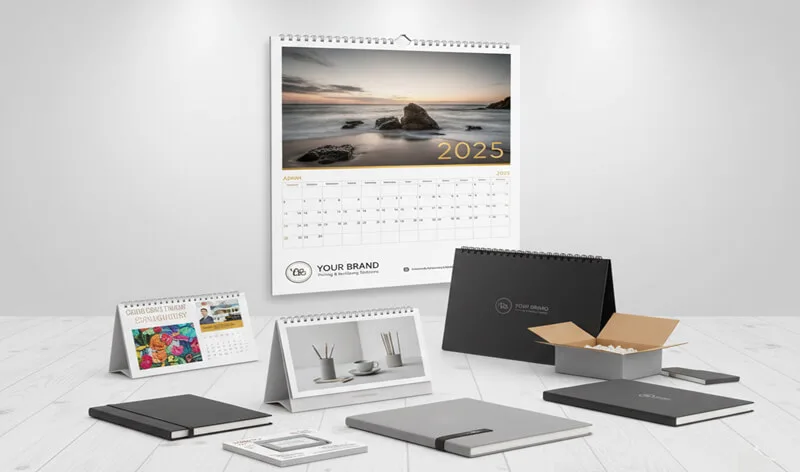
You’ve spent weeks perfecting your brand’s calendar design. The photography is stunning. The layout is clean. Your team approved every single month. Then it arrives at your client’s doorstep… with dog-eared corners and a crease down the middle. I’ve watched this happen more times than I can count. Companies invest thousands in premium calendar printing, then ship everything in standard manila envelopes that cost 47 cents. It’s like wrapping a Rolex in newspaper.
Here’s what nobody tells you: the unboxing experience of your calendar matters just as much as what’s printed on it. Maybe more. Let me walk you through everything we’ve learned after producing thousands of calendar kits for brands that actually care about the whole experience not just the print quality.
The Calendar Problem Nobody’s Talking About
Digital fatigue hit differently in 2025. Your customers are drowning in emails they’ll never read and push notifications they’ve learned to ignore. Meanwhile, a well-designed calendar hangs on someone’s wall for an entire year. That’s 365 days of brand exposure. But here’s the twist: most companies get the printing right and completely botch the delivery. Think about it from your customer’s perspective. They open their mailbox and pull out a bent, damaged envelope. Before they’ve even seen your beautiful design, they’re already disappointed. That’s not the brand experience you paid for.
The solution? Treat your calendar like the marketing asset it actually is. That means premium printing paired with packaging that protects and presents your work properly. We call this the “Calendar Kit” approach—and it’s changed how our clients think about calendar campaigns entirely.
Choosing the Right Calendar Format (Because One Size Definitely Doesn’t Fit All)
Walk into any office in January and you’ll see the same thing: different calendars serving completely different purposes.
The Boardroom Choice: Wire-O Wall Calendars
These are the workhorses of the calendar world. Wire-O binding lets pages lay perfectly flat against the wall, which sounds minor until you realize how many cheap calendars curl and look sloppy by February. We’ve printed Wire-O calendars for law firms, medical practices, and architecture studios. They project professionalism. The pages flip smoothly during client meetings. Nobody’s fighting with spiral binding that snags. Real talk though these need rigid mailers for shipping. I’ve seen too many arrive bent because someone tried to save a dollar on packaging.
The Work-From-Home Essential: Easel-Back Desk Calendars
Remember when everyone worked from home in 2020? Turns out that didn’t fully reverse. Desk calendars exploded in popularity because people wanted something tactile on their home office desk. These work incredibly well for financial services companies, tech startups, and any brand targeting remote professionals. They’re visible during every video call. They sit right next to where people work. The smart brands? They package these in custom boxes that feel like a gift. Because they kind of are.
The Service Hero: Magnetic Calendars
Plumbers love these. So do realtors, HVAC companies, and basically anyone who wants their phone number stuck to a customer’s refrigerator for twelve months. Magnetic calendars are pure utility. They’re not trying to be beautiful—they’re trying to be useful. And useful gets remembered when someone’s water heater breaks at 11 PM. Shipping tip: these need special handling because of the magnetic backing. Standard envelopes don’t protect them properly.
2025 Trend Alert: Poster Calendars
Here’s something interesting we’ve noticed: more designers are ditching the monthly flip format entirely. Instead, they’re creating single-sheet poster calendars with the entire year visible at once. The aesthetic is minimal. Very Scandinavian. Lots of white space. The whole thing feels more like art you’d frame than a traditional calendar. These work beautifully for lifestyle brands, creative agencies, and companies targeting design-conscious customers. But they absolutely require tube shipping or flat rigid mailers. You can’t fold a poster calendar and call it premium.
Design Specs That Actually Matter (Skip This and You’ll Reprint)
Let’s talk about the technical stuff that prevents expensive mistakes.
Bleed: The 0.125″ Rule
Every calendar needs a bleed—that’s the extra 0.125 inches around your design that gets trimmed off. Without it, you risk white edges if the cutting isn’t perfectly aligned. I know it seems picky. But I’ve watched designers spend hours perfecting their layout, only to have the final product show thin white lines because they ignored bleed specifications. Add the bleed. Save yourself the headache.
CMYK vs. RGB: Yes, This Still Matters
Your design looks gorgeous on your screen. That’s RGB color—which is how screens display color using light. But printing uses CMYK—which is how ink on paper displays color. And they’re not the same. That bright blue that pops on your monitor? It’ll print darker. Those vibrant greens? They’ll shift. Convert your files to CMYK before you send them, and check how everything actually looks in print color space. Most printing issues we see? This is the culprit.
Resolution: 300 DPI or Go Home
Low-resolution images look fine on a phone screen. They look terrible at 11×17 inches on someone’s wall. Every image in your calendar needs to be at least 300 DPI at the size it’ll be printed. That Instagram photo you want to use? It’s probably 72 DPI. It won’t work. This is where companies usually discover they need to reshoot product photography. Better to know now than after you’ve printed 1,000 calendars with blurry images.
Interactive Print: Making Calendars Do More
Here’s where things get interesting. Smart brands aren’t just printing static calendars anymore—they’re adding interactive elements that bridge print and digital.
QR Codes with Purpose
Put a QR code on your March page that unlocks a spring discount. Add one to October that links to holiday gift guides. The calendar becomes a twelve-month engagement tool instead of just something people glance at. We’ve seen this work exceptionally well for e-commerce brands and service companies running seasonal promotions. The key is making each code offer something valuable—not just linking to your homepage.
Augmented Reality (No, Really)
This sounds futuristic, but it’s happening now. Customers scan your calendar page with their phone and watch a 3D model appear, or a video message from your CEO, or a virtual tour of your facility. Is it necessary? No. Is it memorable? Absolutely. We’ve helped a handful of clients implement this, mostly in the automotive and real estate industries. The “wow factor” is real—but you need to commit to creating the AR content, which isn’t trivial.
Paper Textures and Finishes
Here’s a trend that matters more than you’d think: tactile experiences. Soft-touch lamination feels velvety when you run your fingers across it. Textured papers (like linen or felt finishes) create a premium impression immediately. Even the weight of the paper stock communicates quality. We’re seeing more brands move away from glossy finishes toward matte and soft-touch options. It feels more sophisticated. Less “we printed this at the mall kiosk.”
The iPackU Difference: Where Packaging Becomes Part of Your Brand
This is the part that separates companies who “print calendars” from companies who create complete brand experiences.
Stop the Dog-Ears: Why Rigid Mailers Matter
Standard manila envelopes cost less. They also bend, crease, and generally destroy your calendars in transit. Rigid mailers—the ones made from heavy chipboard—protect your product. They don’t bend. Your calendar arrives looking exactly like you intended. Yes, they cost more. But if you’re sending calendars to high-value clients or prospects, showing up damaged isn’t an option. The packaging quality reflects directly on your brand quality. We’ve shipped calendars in rigid mailers to Fortune 500 companies, boutique hotels, and luxury real estate firms. Nobody complains about the packaging being “too nice.”
Branded Mailers: Starting the Experience at the Mailbox
Why should the outside of your shipping package be boring? Print your logo on the mailer. Add your brand colors. Include a tagline. The brand experience should start the moment someone pulls your package from their mailbox—not when they open it. This is especially powerful for B2C brands doing direct mail campaigns. In a stack of boring brown packages, yours stands out immediately.
The Gift Experience: Custom Boxes for Desk Calendars
If you’re sending desk calendars as corporate gifts, generic packaging misses the entire point. Custom boxes elevate the whole experience. We’re talking about boxes with magnetic closures, tissue paper, maybe a handwritten note card tucked inside. When someone opens it, it should feel like receiving a present—because that’s exactly what it is. The brands doing this well? They’re the ones getting thank-you emails and social media posts from recipients. That’s earned media you can’t buy with ads.
Eco-Packaging: Meeting 2025 Expectations
Sustainability isn’t a nice-to-have anymore. It’s a baseline expectation, especially with corporate buyers. The good news: plastic-free packaging options exist at every price point. Recycled chipboard mailers. FSC-certified boxes. Water-based inks. Compostable protective layers. When you tell a procurement team your calendar kit is fully recyclable with no plastic components, that’s often the difference between winning and losing the contract. We’re transparent about this: sustainable packaging costs slightly more. But we’ve never had a client regret making that choice.
Fulfillment & Distribution: The Logistics Nobody Wants to Handle
Printing calendars is one thing. Getting them to thousands of individual addresses is something entirely different.
Kitting: The Secret Weapon for Memorable Campaigns
Kitting means assembling multiple items together before shipping. Your calendar plus a branded pen plus a discount card plus a handwritten note—all packaged as one unit. This turns a calendar into a complete marketing kit. And we can handle the assembly, which means you don’t need to rent warehouse space and hire temporary staff to stuff envelopes. We’ve kitted everything from simple calendar-plus-card combinations to elaborate gift boxes with multiple branded items. The impact on recipient engagement is measurable.
Drop-Shipping vs. Bulk: Know Your Distribution Strategy
You have two main options:
Bulk shipping:
We send all 5,000 calendars to your warehouse, and your team handles individual distribution.
Drop-shipping:
You send us a mailing list, and we ship directly to each recipient.
Bulk makes sense if you have existing fulfillment infrastructure and want maximum control. Drop-shipping makes sense if you’d rather not handle logistics, need personalized messaging for each recipient, or want to avoid warehouse storage costs. Most of our corporate clients choose drop-shipping. Most retail brands doing calendar sales choose bulk.
Timeline Reality Check: Why October Orders Are Late
Let’s be honest about production realities. Quality calendar printing takes time. Design approval, proofing, actual printing, binding, packaging, and shipping—we’re talking four to six weeks minimum for custom projects. If you want calendars in mailboxes before December, you need to order by October at the latest. Ideally earlier. Every November, we get panicked calls from companies who just realized they need 2,000 calendars in two weeks. We do our best, but rush orders mean limited options and higher costs. Plan ahead. Future you will be grateful.
Cost Optimization & ROI: Making the Numbers Work
Calendar campaigns aren’t cheap—but they’re one of the highest-ROI print marketing tools available when done right.
Standardization Saves Money
Custom sizes look unique. They also cost more because we can’t optimize paper usage. Standard sizes (8.5×11, 11×17, 12×12) fit efficiently on press sheets. That means less paper waste and lower unit costs. If budget matters (and it always matters), start with standard sizes. You can still create stunning designs within those dimensions.
Bulk Pricing Tiers: Where Economics Shift
Here’s roughly how pricing scales:
- 100 calendars: You’re paying premium per-unit costs
- 500 calendars: Costs drop significantly (often 30-40%)
- 1,000+ calendars: This is where economies of scale really kick in
- 5,000+ calendars: You’re approaching wholesale pricing levels
If you’re on the fence between 450 and 550 units, always go to 550. The per-unit savings at the 500+ tier more than cover the extra quantity.
ROI Calculator: Why Calendars Justify Their Cost
Let’s do simple math.
Say each premium calendar kit costs you $8 (printing, rigid mailer, kitting, shipping). You send them to your top 200 clients.
Total investment: $1,600.
If just ONE of those clients places an additional order because your calendar kept your brand top-of-mind all year, what’s that worth?
For most B2B companies, a single client is worth thousands to tens of thousands in annual revenue. The calendar ROI becomes obvious pretty quickly.
We’ve had clients tell us their calendar campaigns directly led to contract renewals, referrals, and new project opportunities. That’s impossible to track with perfect accuracy, but the correlation is hard to ignore.
Wrapping This Up (See What I Did There?)
Look—you can print calendars a hundred different ways. You can ship them in whatever packaging is cheapest. You can treat them like commodities. Or you can recognize that a calendar is one of the few physical marketing pieces that earns a permanent spot in someone’s office or home for an entire year.
That’s worth doing right.
Premium printing paired with protective, branded packaging turns calendars from “another promotional item” into something people actually appreciate receiving. Something that reflects well on your brand every single day. If you’re planning a 2025 calendar campaign, here’s what to do next:
Download our 2025 Calendar Design Template to ensure your files are print-ready from the start. It includes all the bleed, resolution, and color specifications we’ve covered—so you avoid expensive revisions.
Get a Quote for Printing + Custom Packaging to see exactly what a complete calendar kit costs for your specific quantities and formats. We’ll walk you through options that fit your budget and timeline.
The brands that win with calendar marketing? They’re the ones who realize packaging isn’t an afterthought—it’s half the product. Let’s make your 2025 calendars something people actually want to receive.