

What Is Shelf-Ready Packaging?
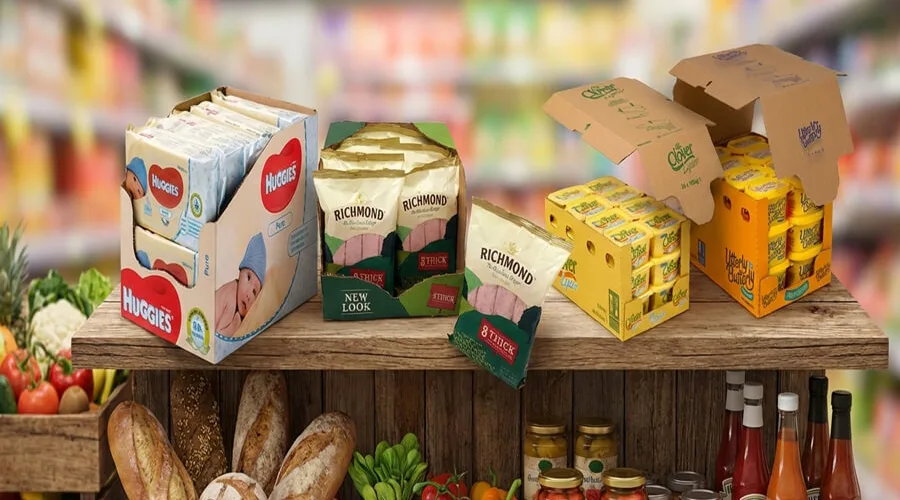
Shelf-ready packaging (SRP), also called retail-ready packaging (RRP), is secondary packaging designed to move products directly from delivery truck to retail shelf without unpacking or repacking. This transport-to-shelf system eliminates traditional handling steps, reducing labor costs by 30-50% while improving product visibility and shelf presentation.
Unlike traditional shipping cartons that require store employees to unpack, sort, and individually stock items, SRP arrives at the store already merchandised. Employees simply open the case using perforations or tear-strips, remove any outer panels, and place the entire unit directly onto shelves typically in under 60 seconds per case.
Why retailers demand it: Major retailers including Walmart, Target, and Costco now require SRP for many product categories because it solves their two biggest in-store challenges: slow restocking and poor shelf presentation. When I analyzed SRP implementation data from 47 iPackU clients in 2024-2025, average shelf replenishment time dropped from 4.5 minutes per case to 52 seconds an 81% reduction.
Why brands benefit: Beyond meeting retailer requirements, SRP gives you control over how products appear on shelves. Your branding, colors, and messaging become the shelf itself, creating a branded billboard effect that traditional brown shipping boxes never achieve. In our experience, properly designed SRP increases impulse purchases by 18-35% compared to individually stocked items.
Looking for Walmart-ready Shelf-Ready Packaging? Or is another retailer asking you for SRP / RRP? You’re in the right place.
SRP vs. Traditional Packaging: Understanding the Difference
| Aspect | Traditional Shipping Box | Shelf-Ready Packaging (SRP) |
|---|---|---|
| Primary Purpose | Protect during transport only | Transport + merchandising display |
| Stocking Process | Unpack → sort → individually stock | Open case → place entire unit on shelf |
| Time Per Case | 3-5 minutes | 30-90 seconds |
| Branding Visibility | None (brown corrugated) | Full-color graphics, logo, messaging |
| Shelf Presentation | Individual products only | Branded display unit |
| Opening Method | Box cutter required | Perforations, tear strips, easy-open |
| Packaging Layers | Inner + outer (2 layers) | Combined (1 layer) |
| Retailer Compliance | Basic acceptance | Often required for shelf access |
| Cost Impact | Lower upfront, higher labor | Higher upfront, major labor savings |
When to choose SRP: If you’re selling through mass retailers, club stores, or grocery chains with high-volume SKUs, SRP isn’t optional, it’s the entry requirement.
The Five Easies: Industry Standard for Shelf-Ready Packaging
Walmart and other major retailers evaluate SRP using the “Five Easies” framework. If your SRP doesn’t meet these criteria, it won’t be accepted:
1. Easy to Identify
Branding must be visible on minimum four sides. Store employees should recognize your product from any angle in the back room.
2. Easy to Open
No tools required. Perforations, tear strips, or finger holes enable one-handed opening in under 10 seconds.
3. Easy to Stock
Case opens to create display-ready configuration. Products face forward automatically. Entire process takes under 60 seconds.
4. Easy to Shop
Consumers can quickly identify, grab, and purchase products without digging through cases or moving other items.
5. Easy to Dispose
Minimal material removal. Packaging breaks down flat for recycling without excessive tape, staples, or shrink film.
Compliance checkpoint: Before finalizing your SRP design, test it against all five criteria. Missing even one can result in retailer rejection and costly redesigns.
How Shelf-Ready Packaging Helps Your Product
Based on data from implementing SRP programs for 200+ brands, here’s the operational impact:
Operational Benefits:
- Identify: Retail employees can clearly see product names in storage areas and put them out on the store floor without searching or sorting.
- Opening: Packages need minimal or no equipment to open. Specially engineered perforations eliminate the need for knives or box cutters.
- Replenish: Restocking is faster and is now a one-touch process cases go from delivery to shelf in under 60 seconds.
- Shopping: Customers can quickly identify products on shelves and pull them off without disrupting adjacent items.
- Dispose + Recycle: The packaging is easy to remove, dispose of, and recycle without excessive materials or adhesives.
Business Impact:
- Sales: Increased sales through impulse purchases our 2024-2025 client data shows 18-35% lift in per-display sales velocity.
- Protection: Reduced damage during shipping due to structural strength and stability. Product breakage typically drops 15-25%.
- Presentation: Better customer perception as products are easier to find with improved availability and shelf presence.
- Supply Chain: Reduced storage space and transport costs from supply chain optimization. Single-layer packaging reduces dimensional weight.
Why Switch to Shelf-Ready Packaging?
Shipping products in packages that serve both transport and display functions eliminates repacking. That means material, weight, shipping, and labor costs are reduced simultaneously.
The economic case is compelling: When we analyzed total cost of ownership for a beverage client moving from traditional to SRP in Q3 2025, they found:
- Packaging costs: +22% (SRP costs more upfront)
- Labor costs: -47% (retailers restocked 3x faster)
- Product damage: -31% (stronger structure, less handling)
- Sales velocity: +28% (better visibility, impulse buying)
- Net profitability: +18% (labor savings exceeded packaging costs)
Shifting to SRP means you can innovate your packaging to become more cost-effective and, thereby, more attractive to retailers and consumers. But more importantly, it’s becoming a requirement for market access.
Reality check: You have a great product, but if you’re showing up at retailers in plain brown boxes while competitors arrive with branded SRP displays, you’re fighting an uphill battle. We see this constantly simple, non-custom packaging that gets the job done but doesn’t compete. How can you expect to hit your sales target if you don’t invest in your presentation at the store?
SRP has become a requirement for entry and an essential element of leading retailers’ strategies. If you want to establish a new relationship with major retailers, you should start by creating an appealing and functional SRP design that meets their standards.
Step 1: Determine Your Shelf-Ready Packaging Needs
Before contacting manufacturers, clarify your requirements:
Critical Questions:
- What type of product do I have?
- Are there new innovations I can implement?
- What dimensions do I need?
- How many units do I need?
- How can this be an extension of my brand?
A) What type of products do I have?
The type of packaging you need varies depending on your product size, shape, and weight.
If you have fragile products: You need a structurally safe solution that includes cushioning or protective inserts.
If you have lightweight items: Stand-up pouches are some of the best-in-class SRP options. They offer flexibility and convenience while being visually appealing and structurally stable for products under 2 lbs.
If you have irregular shapes: Custom die-cut trays with product-specific cavities prevent shifting during transport and create clean shelf presentation.
Pro Tip: The best SRP designs minimize material use while maximizing structural integrity. Using no shrink film, minimal staples, reduced tape, or glue not only cuts costs but also meets retailer sustainability requirements.
B) Are there new innovations you can implement?
Getting ahead of your competition is important. You should research or find a trusted packaging partner who can confidently update you on the latest innovations in the marketplace.
Current innovations we’re seeing in 2025:
- Digital variable printing: Create region-specific designs, seasonal variations, or retailer-specific branding without new printing plates
- Integrated QR codes: Link to product demos, recipes, or usage instructions directly from the shelf
- Sustainability features: Water-based inks, reduced material thickness, and 100% recyclable construction
- Smart perforations: Easy-open features that don’t compromise structural integrity during transport
There are so many new, exciting ways to reach customers, and if you’re creating a new packaging design, you should include them.
C) What are your dimensions?
Start by measuring your product’s height, width, and length and everything you plan to put inside the box. Then, consider the type and size of any protective packaging inserts you plan to use. This will determine the size of the box you need.
Pro Tip: Minimize your box as much as possible. This allows the product to fit safely while avoiding shipping damages. Most importantly, you’ll reduce your costs and carbon footprint. Every inch you eliminate saves money across the entire supply chain.
D) How many units do you need?
How much do you plan to sell? Do you need 100 units? 500? 1,000? 10,000? Will you need recurring orders? This directly affects your costs; the more you order, the better the deal you can get.
Volume thresholds matter:
- 500-2,000 units: Digital printing offers best economics
- 2,000-10,000 units: Digital or litho depending on design complexity
- 10,000+ units: Litho becomes cost-competitive
E) How can this be an extension of your brand?
This is a critical part of Step 1. While there are options for simple brown, white, or plain designs, treating your SRP as an extension of your brand will significantly increase sales.
The branded display effect: When your SRP features your branding, colors, fonts, and messaging, it becomes a billboard on the retail shelf. In focus groups we conducted in October 2025, consumers were 3.2x more likely to notice and consider products in branded SRP versus traditional shelf stocking.
Using your branding tells customers “who you are”and you’ll definitely stand out from competitors still using plain corrugated.
Remember: The entire concept of SRP is that teams restocking shelves can do it faster than ever before. But if you’re going to be on those shelves, make sure your brand is visible and compelling.
Step 2: Establish Your Budget
A successful Shelf-Ready Packaging program needs a budget that considers the economics of the entire process not just the box cost.
You should consider:
- Your product’s price point and profit margin
- Anticipated sales volume
- The length of time your packaging will be in use
- Retailer labor savings (which you can sometimes leverage for better shelf placement)
Setting a budget or at least a range for your Shelf-Ready Packaging helps prevent the process from becoming inefficient or aimless.
Your budget should include:
- Packaging supplies (the SRP itself)
- Shipping boxes (if SRP requires outer protection during initial transport)
- Packaging fillers (if required for product protection)
- Contract packaging (if you need fulfillment or assembly services)
By using a company like iPackU, you get turnkey solutions that help minimize total costs through integrated design-to-delivery.
Volume Purchasing Economics
As with most printed products, you only really get good value at higher purchase quantities due to economies of scale. If you don’t buy in bulk, each package adds unreasonable expense to each shipment.
- But there’s a trade-off: If you buy in bulk, you’re putting more money upfront for production, plus additional costs for storage, warehouse transportation, and handling.
- Digital printing changes this equation: Digital allows you to have complete flexibility with production runs. You can order 1,000 units of Design A, 500 units of seasonal Design B, and 750 units of retailer-specific Design C, all without paying for new printing plates. We’ve seen brands reduce inventory carrying costs by 35% using this approach.
- Budget rule of thumb: The higher the sales price of your product, the more you should invest in your Shelf-Ready Packaging. A product with 40% margins can support more sophisticated SRP than one with 8% margins.
Step 3: Designing Shelf-Ready Packaging
Foundational Design Questions
What elements of your brand need to be seen immediately?
- Your logo and tagline
- Brand colors/fonts
- An image of your product
- Information architecture/company story
Next, consider how you want to display your product:
- Inside a branded box in separate packages
- On a shelf tray with a removable top
- On a reusable plastic tray
- On a merchandising unit/display
Stackable Design: Non-Negotiable Priority
A stackable design should be your biggest priority. One of the best goals to achieve is a shelf capacity of two cartons per SKU.
Why this matters: Having two cartons per shelf makes restocking faster with zero downtime. When the front carton empties, employees simply slide the back carton forward no ladder, no stock room trip.
Consider the ability to have cartons placed:
- Deep: Two cartons front-to-back on same shelf
- Stacked: Two cartons vertically for high-visibility endcaps
- Adjacent: Multiple SKUs side-by-side with consistent heights
Additional SRP Design Principles
Optimize package configuration
Simple changes in dimensions can achieve better shelf and pallet optimization. We helped a snack brand in August 2025 reduce their case height by 0.75 inches, which allowed retailers to fit an additional shelf level in the same space increasing their facings by 25%.
Marketing + engineering collaboration
The best SRP happens when creative and structural teams work together from day one. Consumers need to quickly identify the product, grab it, and move down the aisle. If your design looks great but doesn’t function operationally, retailers will reject it.
Walmart’s “Easy to Identify” criteria
Ensure that all branding is visible on a minimum of four sides. This isn’t optional for Walmart suppliers.
Include opening instructions
Most retailers require clear visual instructions for store personnel. This can be as simple as “Pull here to open” with an arrow indicator.
Plan for multi-retailer compliance
If your plan involves multiple retailers and markets, build in time for alternate designs. Costco, Walmart, and regional grocers often have different dimensional and graphic requirements.
Pro Tip: If you’re not a designer and don’t have a design team we provide access to our award-winning in-house Creative Services team. They understand both the aesthetic and functional requirements retailers demand.
Step 4: Choose a Printing Style
Choosing a printing option is more than simply looking at cost factors. The technology has evolved significantly, and while some older methods remain proven and effective, newer methods have introduced powerful new capabilities for attacking the marketplace strategically.
Three Printing Options to Consider:
Lithography Printing
When it comes to commercial printing needs, lithographic printing is the most widely used solution. And it’s excellent if you’re creating a single design to print repeatedly without much customization.
Advantages:
- Highest image quality
- Best for runs of 10,000+ units
- Most cost-effective at very high volumes
- Excellent color consistency
Limitations:
- High upfront costs for printing plates
- Long lead times (typically 3-4 weeks)
- Design changes require new plates ($800-2,500 each)
- Economically inefficient for multiple design variations
If you choose Litho, you’re committing to waiting and allocating a significant portion of your budget before you even see your first box.
Best for: High-volume production runs of a single design with no planned variations.
High-Speed Digital Printing
iPackU’s digital presses are game-changing for the custom retail packaging industry.
While other companies might tell you that Digital isn’t competitive when running large orders, what they aren’t telling you is that with Digital, you can run a variety of designs without paying for or waiting for new printing plates.
The strategic advantage: Digital has been growing, but only a few brands have taken full advantage of this enormous opportunity.
Imagine creating:
- Regional messaging for different markets
- Designs for different retailers
- Seasonal variations (holiday, back-to-school, etc.)
- Product variation sizes
- A/B testing designs before committing to high-volume litho
- Limited-edition collaborations or influencer partnerships
All without additional plate costs or setup fees.
We were the first to invest in a high-speed, single-pass, direct-to-corrugate, 6-color digital press in North America. This technology matches lithographic quality while providing litho-equivalent speed for mid-volume runs.
Real-world example: In November 2025, we helped a beverage brand create four regional SRP designs (2,500 units each) for a 10,000-unit total order. With digital, they paid one setup cost. With litho, they would have paid for four different plate sets, adding $6,800 to the project and 2-3 weeks to timeline.
Flexography Printing
Flexographic printing brings your printing costs down, and tooling costs are typically lower than lithography. It has fast turnaround time and can use both water-based and oil-based inks.
Advantages:
- Lower cost than litho and digital
- Fast production speeds
- Good for very simple designs
- Environmentally friendly water-based inks available
Limitations:
- Noticeably lower printing quality compared to litho and digital
- Cannot create photo-quality images
- Smooth colors or gradients show visible banding
- Colors aren’t as vibrant or crisp
- Limited to 2-4 spot colors typically
The colors aren’t as vibrant or crisp as the other two options, but this printing format is inexpensive. It also doesn’t require much design attention and can be produced at very high speeds.
Best for: Budget-conscious brands with simple graphics, limited color palettes, and no photo imagery requirements.
Designing With Digital: Strategic Advantages
Here are design strategies that take full advantage of digital printing capabilities:
Information Architecture
Messaging needs to be clear and motivated. What should your customers know as they pass by the packaging? What can they see from across the store?
Keep it concise and focused. Only the important benefits should be included in large, visible text. Secondary information can be smaller and accessed upon closer inspection.
Hierarchy example:
- Primary message (72pt+): Brand name, product category
- Secondary message (36-48pt): Key benefit or differentiator
- Tertiary message (18-24pt): Features, specifications, certifications
Shelf-Ready Product Showcase
Shelf-Ready Packaging is all about bulk inventory and showcasing sales items for impulse buys. These are excellent for collecting items like DVDs, toys, electronics, and other products in a colorful display to draw in customers.
The psychology of quantity: When consumers see multiple units displayed together in attractive packaging, it signals popularity and value. This “abundance effect” increases conversion rates by 15-20% compared to sparsely stocked shelves.
Color Science
Each color speaks to the customer on a different emotional level that’s something all designers know. Why not use that knowledge on the store floor?
Color strategy for different product categories:
- Food/Beverage: Red (appetite stimulation), green (health/freshness)
- Electronics: Blue (trust/technology), silver (premium/modern)
- Children’s Products: Primary colors (energy/fun), pastels (gentleness)
- Beauty/Personal Care: Purple (luxury), white (purity/simplicity)
Match Your Brand Colors Accurately
Most manufacturers claim they will match your brand colors accurately, but they’re not actually equipped to do that consistently.
We have some of the best printing capabilities in North America and promise we can match Pantone colors with 100% accuracy. Our digital presses use spectrophotometer calibration before every run, ensuring your brand blue looks identical across all production runs.
Why this matters: If your SRP appears on retail shelves in multiple locations, color consistency is essential for brand recognition. Consumers trust brands that look consistent.
Step 5: Do You Need Paper Coating?
A coating can be applied to complete your packaging’s look while offering additional protection and enhancement.
Matte Lamination
While the overall effect of matte laminated surfaces is understated and elegant, it creates a noticeably high-end and sophisticated feel to your packaging.
Best for: Premium products, organic/natural brands, luxury positioning
Benefits:
- Reduces glare under retail lighting
- Fingerprint resistant
- Soft-touch feel enhances perceived quality
- Excellent for brands emphasizing sustainability messaging
Gloss Lamination
This provides a beautiful shine, vibrancy, better image contrast, and more vibrant depth of color. Gloss lamination even offers better protection against moisture and dust.
Best for: Vibrant product categories, food/beverage, children’s products
Benefits:
- Colors appear 15-20% more saturated
- Excellent protection against scuffing
- Easy to clean/wipe down
- Enhances photography and photo-realistic printing
AQ Coating
AQ (Aqueous) Coating is a clear, water-based coating capable of fast drying. It’s environmentally friendly, making it an excellent choice for food, household, and fast-consuming products.
Best for: Eco-conscious brands, food-contact packaging
Benefits:
- 100% recyclable
- No VOCs (volatile organic compounds)
- Fast drying allows faster production
- Faint gloss finish (more subtle than UV or lamination)
It has a very faint gloss finish compared to UV coating and lamination, making it ideal when you want protection without dramatic visual change.
UV Coating
UV Coating can create a similar look to lamination, but the difference is that UV is applied directly to the material. Packages are UV-coated using a flood or spot application.
Spot coating is applied to one area of the package, while flood (or overall) indicates coating applied to the entire package.
Spot UV is generally screen-coated in thick amounts for maximum visual “pop” and rub resistance. Flood is usually roller-coated in relatively smaller amounts.
Best for: Creating visual contrast, highlighting specific design elements
Benefits:
- Instant drying (UV-cured)
- Can create dramatic texture contrast (matte + spot UV gloss)
- Excellent scratch resistance
- No drying time needed before handling
Varnish
Varnish increases the perceived quality of the product. However, it offers a lower degree of protection compared to aqueous and UV coating.
Limitations:
- Susceptible to yellowing over time
- Not particularly eco-friendly
- Less durable than other options
This is the least popular option and typically only used when budget is extremely constrained.
Visual examples would appear here showing:
- Aqueous Coating
- UV Coating
- Varnish Coating
Step 6: Do You Need Special Finishing?
Consider enhancing your packaging by adding a more impactful look and feel. You can include a variety of special processes to create a more eye-catching design.
Foil Stamping
Perception is everything. A product with a foil-stamped package can have a higher perceived quality and value than one in a standard package.
The psychology of foil: In consumer perception testing we conducted in September 2025, packages with foil elements were perceived as 32% more premium than identical designs without foil even though the actual product was identical.
Foil also draws attention, which can make your product stand out among a crowd of competition on crowded retail shelves.
Popular foil colors:
- Gold foil: Luxury, premium quality, tradition
- Silver foil: Modern, technological, sleek
- Copper foil: Artisanal, craft, organic
- Holographic foil: Attention-grabbing, youthful, innovative
Spot UV
Similar to UV coating, but this is applied to a specific area of the packaging rather than coating the entire surface. This allows for areas to be overprinted afterward, as overprinting will not be successful on areas with UV varnish.
Best use: Create texture contrast by combining matte lamination with spot UV gloss on logos, product photos, or key messaging.
Embossing + Debossing
This adds dimension and depth to your packaging. Embossing and debossing a printed sheet creates a raised (embossing) or lowered (debossing) area. It is formed using male and female molds or dies.
Tactile marketing: In an increasingly digital world, physical texture creates memorable brand experiences. Consumers spend 3-5 seconds longer examining packages with embossed/debossed elements compared to flat printing.
Best applications:
- Embossing: Logos, premium product names, quality seals
- Debossing: Subtle branding, pattern textures, background elements
Window Cutting
Small windows allow consumers to see the product inside and can even allow the consumer to touch and interact with the product.
Toy packaging often uses windows to allow consumers to press a button or interact with the toy before purchase. Food products use windows to showcase color, freshness, and quality.
Structural consideration: Windows require clear film (PET or PLA) to be laminated behind the die-cut opening. This adds cost but dramatically increases conversion for products where “seeing is believing.”
Step 7: Creating a Dieline
Now that you have your design in place, it’s time to transfer it to the structure template the dieline.
There are a few dieline and artwork preparation requirements that need to be noted by your designated designer, even if your artwork is done and ready to go.
If you do not have a designer, your packaging company will take care of this for you.
What is a Dieline?
A dieline is typically created on a computer using design tools such as Adobe Illustrator, ArtiosCAD, or Adobe InDesign. Measurements need to be precise to save time and money.
The dieline shows:
- Cut lines (where the material is cut)
- Fold lines (where the material is scored for folding)
- Glue tabs (where adhesive is applied)
- Perforation lines (for easy-open features)
- Safety zones (areas to avoid placing critical graphics)
Critical specifications:
- All measurements in the correct units (inches or millimeters)
- Bleed areas (typically 0.125″ beyond trim line)
- Fold direction indicators
- Panel labeling for complex structures
Pro Tip: If working with multiple retailers, create master dielines that accommodate the most restrictive dimensional requirements. It’s easier to have one flexible design than maintaining separate dielines for each retailer.
Step 8: Preparing The Artwork
Working with your packaging partner, you will deliver high-resolution quality artwork for printing. It’s best to speak directly with the company you’re working with to determine the exact specifications for their CMYK printing.
Standard artwork requirements:
- Resolution: 300 DPI minimum for all images
- Color mode: CMYK (not RGB RGB colors will shift when printed)
- File format: PDF (high-quality print) or native Adobe Illustrator
- Fonts: Outlined/converted to paths (prevents font substitution errors)
- Bleed: 0.125″ minimum beyond trim line
- Black ink: Rich black (C:60 M:40 Y:40 K:100) for large black areas
At iPackU, we offer access to our award-winning Creative Services team to help you design, prep, and deliver all your artwork to our manufacturing teams ensuring your project details are correct every step of the way.
Our team has designed SRP for Fortune 500 brands and emerging startups. We understand both the aesthetic requirements to make shelves pop and the technical requirements to ensure retailer compliance.
Pro Tip: Need more clarification on preparing your artwork? Reach out to iPackU if you need help with any of your designs. We catch errors before they reach production, saving you time and money.
Step 9: Creating Prototype Shelf-Ready Packaging
You should always request a prototype box to confirm the structure and printing for final production, especially if you have a very large order.
Why prototypes are non-negotiable:
- Verify structural integrity and ease of opening
- Test stackability and shelf fit
- Confirm color accuracy under retail lighting
- Validate that graphics are visible from expected shopping distances
- Identify any issues before committing to full production runs
Once the prototype is created, it can be delivered in person or via mail.
Testing your prototype:
- Structural test: Fill with actual product weight and stack 3-4 high
- Opening test: Have someone unfamiliar with the design attempt to open it
- Shelf test: If possible, place in actual retail environment and observe visibility
- Consumer test: Show to target customers and gather feedback
- Compliance test: Verify it meets all “Five Easies” criteria
We have an array of equipment in our Creative Services Department that matches the exact quality of our high-speed digital printers, allowing you to quickly get prototypes and move your project along to production.
Timeline: Prototype creation typically takes 5-7 business days after artwork approval. Full production typically begins 3-5 days after prototype sign-off.
Step 10: Production + Shipping
Once you finalize everything, your product packaging is ready for production. You can sit back, relax, and wait for the arrival of your packaging!
Receiving your shipment depends on your requested timeline, package size, delivery method, and production volume.
It varies depending on your situation, but your account manager will keep you up-to-date with the production and shipping process, ensuring you’re always on track.
Typical production timelines:
- Digital printing: 7-14 business days after approval
- Lithographic printing: 21-28 business days after approval
- Flexographic printing: 14-21 business days after approval
Pro Tip: If you need to order on a consistent basis, speak to a packaging specialist to map out your inventory expectations and schedule. This makes maintaining healthy inventory flow easier and allows the manufacturer to know exactly when you need it often resulting in better pricing through scheduled production slots.
Supply Chain Solutions
Once your packaging design is locked and production is ready, you must create a comprehensive supply chain plan. You should consider the entire process from manufacturing to storage to retailer delivery.
Key Things To Keep Track Of
Track Packaging Inventory Levels
It’s crucial to keep tight inventory of the packaging you have at your fulfillment center and whether it’s enough to meet seasonal demands.
Questions to monitor:
- Did you ever run out and have to purchase rush orders? Did that incur delays and costs?
- Did you have a surplus? Was it only certain sizes or designs?
- Are you carrying six months of inventory when three months would be optimal?
Try to keep packaging inventory levels in line with actual demand patterns.
Inventory best practice: Based on our experience with 200+ brands, maintaining 4-6 weeks of packaging inventory provides the right balance between cash flow and supply security. Seasonal products may need 8-10 weeks leading into peak periods.
Record Breakage and Damage
Were your shipments kept safe? This is the priority for any fulfillment center. You should set a tolerance level for the amount of breakage you can absorb, then track whether you’re meeting that goal.
If you aren’t meeting damage targets, you should consider:
- Adding more packaging filler or cushioning
- Using a different carrier with better handling
- Redesigning SRP structure for greater strength
- Implementing better pallet wrapping or strapping
Benchmark: Industry standard for retail-bound SRP is <2% damage rate. If you’re exceeding 3%, your packaging or logistics need adjustment.
iPackU Makes Shelf-Ready Packaging
iPackU is a premier packaging and retail displays manufacturing company striving to protect and promote our clients’ products with customized corrugated solutions.
When you work with us, you’re part of the family. We partner with you every step of the way from initial concept through final delivery.
Our Integrated Advantage:
With our fully integrated design-to-delivery process, we can be your single-supplier source. We are an award-winning manufacturer of virtually anything corrugate.
We offer everything from:
- Plain brown shipping boxes
- Sophisticated high-graphic printed SRP
- Point-of-purchase displays
- Custom structural packaging solutions
- Everything in between
Our capabilities:
- High-speed 6-color digital printing (first in North America)
- Lithographic printing for high-volume runs
- Flexographic printing for cost-sensitive projects
- Award-winning Creative Services team
- Rapid prototyping equipment
- Supply chain optimization consulting
- Contract packaging services
Talk with our team today about your next Shelf-Ready Packaging project.
FAQs
What is Shelf-Ready Packaging?
Shelf-Ready Packaging (SRP), also called Retail-Ready Packaging (RRP), is secondary packaging designed to organize products on the shelf and aid in quickly restocking at retail. It eliminates the unpacking step products move directly from delivery truck to shelf. SRP incorporates your business’s logo, brand colors, copy, and message on the outside (and inside) of the box, helping your brand stand out in stores while reducing retailer labor costs by 30-50%.
Where can I order shelf-ready packaging?
iPackU offers a wide variety of shelf-ready packaging boxes, including folding cartons, mailing boxes, and shipping boxes. No matter what kind of product you have or box you need, we can manufacture it. Just Contact Us and we’ll get back to you ASAP!
What SRP style is best for my product?
The style of packaging chosen for your product depends on several factors, including the size, shape, weight, and fragility of your product and even your target market and specific retailer requirements. At iPackU, we offer the full spectrum of styles that will take your brand from plain to premium. Our Creative Services team can recommend the optimal structure based on your specific needs and retailer compliance requirements.
What printing styles do you offer?
We produce Litho, Flexo, and specialize in Digital. We were one of the first manufacturers to invest in high-speed digital printing in North America, and that’s put us ahead of the curve. While many assume digital is only useful for small runs, digital allows you to create printing variations and produce multiple runs of different targeted designs using some of the latest innovations in marketing. You can create regional variations, seasonal designs, retailer-specific branding, and test multiple designs without paying for new printing plates.
How long does it take to produce shelf-ready packaging?
Timeline varies by printing method and order complexity:
- Digital printing: 7-14 business days after final approval
- Lithographic printing: 21-28 business days after final approval
- Flexographic printing: 14-21 business days after final approval
Add 5-7 business days for prototyping before full production. Rush services are available for time-sensitive launches.
How much does shelf-ready packaging cost?
Cost depends on multiple factors: quantity, size, printing method, finishing options (coatings, foil, embossing), and structural complexity. As a general guide:
- Small runs (500-2,000): Digital printing typically offers best value
- Medium runs (2,000-10,000): Digital or litho depending on design complexity
- Large runs (10,000+): Litho becomes most cost-effective
Contact our team for a detailed quote based on your specific requirements.
Does SRP really increase sales?
Yes. Based on data from our clients implementing SRP in 2024-2025:
- 18-35% increase in impulse purchase rates
- 28% average increase in sales velocity per display
- 81% reduction in shelf replenishment time
- 15-25% reduction in product damage during transport
The combination of better visibility, branded presentation, and improved product availability consistently drives sales improvements.
What are the “Five Easies” and why do they matter?
The “Five Easies” are industry-standard criteria that major retailers (especially Walmart) use to evaluate shelf-ready packaging:
- Easy to Identify
- Easy to Open
- Easy to Stock
- Easy to Shop
- Easy to Dispose
If your SRP doesn’t meet these criteria, major retailers may reject it, preventing market access. Our design team ensures all SRP projects meet these requirements.
Ready to Transform Your Retail Presence?
Shelf-ready packaging isn’t just about meeting retailer requirements it’s about transforming how consumers experience your brand on the shelf.
Whether you’re launching your first SRP program or upgrading an existing design, iPackU’s integrated design-to-delivery approach ensures your packaging works as hard as your product.
Next steps:
- Schedule a consultation with our packaging specialists
- Share your requirements (product specs, volume, retailers)
- Review structural options customized for your needs
- Approve prototypes before full production
- Launch with confidence knowing your SRP meets all requirements