


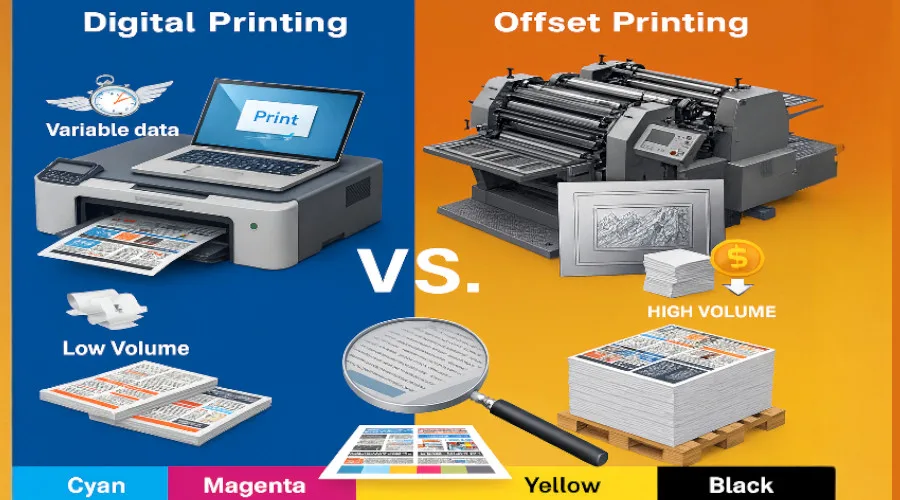
Digital printing excels for short runs and variable data projects, while offset printing dominates large-volume jobs requiring premium quality. Understanding these key differences helps businesses choose the most cost-effective printing method for their specific needs.
Digital Printing vs Offset: The Complete Decision Guide
Choosing between digital printing and offset printing can make or break your project budget. I’ve seen countless businesses waste thousands simply because they picked the wrong printing method. The truth is, there’s no universal “best” choice – it all depends on your specific requirements.
Last month, a client came to me frustrated after spending $3,000 on offset setup for just 50 business cards. They could’ve achieved the same quality with digital printing for under $100. This happens more often than you’d think.
Quick Facts: Digital vs Offset Printing
| Factor | Digital Printing | Offset Printing |
|---|---|---|
| Best for quantity | 1-500 pieces | 500+ pieces |
| Setup time | Minutes | Hours to days |
| Cost per unit (low qty) | Lower | Higher |
| Cost per unit (high qty) | Higher | Lower |
| Variable data | Yes | No |
| Color accuracy | Good | Excellent |
| Paper options | Limited | Extensive |
Understanding Digital Printing Technology
Digital printing works like your office printer, but on steroids. Instead of creating physical plates, digital printers receive files directly from computers and apply toner or liquid ink straight onto paper.
The magic happens in two main ways:
- Laser/LED technology uses toner particles fused to paper with heat
- Inkjet systems spray microscopic ink droplets with incredible precision
This direct approach eliminates the lengthy setup process that offset printing requires. You can literally walk into a print shop with a USB drive and walk out with finished products in under an hour.
The Digital Printing Advantage
Speed That Actually Matters When deadlines loom, digital printing becomes your lifeline. I’ve helped clients produce event materials with just 24 hours notice – something impossible with offset printing’s lengthy setup requirements.
Variable Data Capabilities Here’s where digital printing truly shines. Need 1,000 postcards with different names and addresses? Digital handles this effortlessly. Each piece can be completely unique – different images, text, even layouts.
Cost-Effective Short Runs The math is simple: no plates mean no setup fees. For quantities under 500, digital printing typically costs 40-60% less than offset.
When Offset Printing Still Reigns Supreme
Don’t write off offset printing entirely. This century-old technology still dominates certain scenarios for good reasons.
Unmatched Quality Standards Offset printing delivers superior color accuracy and sharper detail. The indirect transfer process (ink to plate to blanket to paper) creates smoother gradients and more consistent results across thousands of copies.
Premium Paper and Specialty Inks Want metallic gold foiling? Fluorescent colors? Textured papers? Offset printing accommodates virtually any material or ink type, while digital printing remains limited to standard papers and CMYK colors.
Volume Economics Once you cross the 500-1,000 piece threshold, offset printing’s per-unit costs plummet. Large corporations save thousands by leveraging these economies of scale.
Detailed Cost Comparison: Real Numbers
Let’s break down actual costs for common projects:
Business Cards (500 qty)
- Digital: $89-120
- Offset: $180-250 (including setup)
Flyers (2,000 qty)
- Digital: $340-400
- Offset: $280-320
Brochures (5,000 qty)
- Digital: $1,200-1,400
- Offset: $800-950
Notice how the crossover point sits around 1,000-1,500 pieces for most standard projects.
Quality Considerations: Beyond the Basics
Color Matching Reality Digital printing has improved dramatically, but offset still edges ahead for brand-critical colors. If your logo uses a specific Pantone color, offset ensures perfect consistency across all materials.
Paper Texture and Feel Offset printing works with virtually any paper stock – from ultra-thin onion skin to thick cardboard. Digital printers have weight and texture limitations that might affect your vision.
Finishing Options Die-cutting, embossing, and special coatings integrate seamlessly with offset workflows but require separate processes (and costs) with digital printing.
Making the Right Choice: Decision Framework
Ask yourself these three questions:
- Quantity: Are you printing more or less than 500 pieces?
- Timeline: Do you need results in days rather than weeks?
- Customization: Does each piece need unique information?
If you answered “less,” “days,” or “yes” to any question, digital printing likely fits better.
Hybrid Approaches: Getting the Best of Both
Smart businesses often use both methods strategically. Print your core brochures via offset for cost savings, then handle variable postcards and small-batch materials digitally.
This hybrid approach maximizes efficiency while controlling costs. Many successful marketing campaigns combine offset-printed base materials with digitally customized inserts.
Environmental Impact Considerations
Digital printing generally produces less waste since it eliminates plate production and setup materials. However, offset printing becomes more environmentally efficient at higher volumes due to better ink utilization rates.
Both methods now offer eco-friendly options, including soy-based inks and recycled paper stocks.
Future-Proofing Your Printing Strategy
Technology continues advancing rapidly. Digital printing quality improves annually, while offset printing explores faster setup methods. Stay flexible and reevaluate your printing strategy every 2-3 years.
Consider your business growth projections too. A startup might start with digital printing but transition to offset as volumes increase.
Expert Tips for Maximum Results
For Digital Projects:
- Provide high-resolution files (300 DPI minimum)
- Use RGB color profiles, not CMYK
- Request proof prints for color-critical work
- Plan for slight color variations between batches
For Offset Projects:
- Order 10-15% extra to account for setup waste
- Provide Pantone color specifications
- Allow 7-14 days for production
- Consider gang printing multiple items together
Common Mistakes to Avoid
The biggest error I see is choosing based on initial cost alone. Factor in your time value, quality requirements, and long-term needs. A slightly higher upfront cost often saves money and headaches later.
Another mistake: underestimating turnaround times. Digital printing spoils us with speed, but offset printing requires patience for superior results.
FAQ’s
What is the main difference between digital and offset printing?
Digital printing prints files directly on paper. Offset printing uses plates to transfer ink on paper. Digital printing works best for short runs. Offset printing works best for large runs.
When should I choose digital printing over offset?
Choose digital printing when you print under 500 copies. Choose digital printing when you need fast delivery. Choose digital printing when you need variable data.
Is digital printing quality good enough for professional use?
Digital printing gives sharp images. Digital printing gives bright colors. Digital printing works well for most professional jobs.
How much more expensive is offset printing for small quantities?
Offset printing costs 40% to 80% more for small runs. Offset printing adds setup and plate costs. Digital printing costs less for low quantities.
Can digital printing match Pantone colors exactly?
Digital printing cannot match Pantone colors exactly. Digital printing uses CMYK colors. Offset printing uses Pantone ink for exact colors.
What’s the fastest turnaround time for each printing method?
Digital printing delivers jobs in hours. Offset printing takes 5 to 14 days. Digital printing works best for urgent jobs.